blank
  important news
  about the board
  consumers
continuing education
  discipline
  faqs
  laws and rules
  license verification
  licensing info
  meeting schedule
  minutes
  publications
  vet med student loan program
   
  veterinary board home


OHIO VETERINARY MEDICAL LICENSING BOARD
COMPLAINT & INVESTIGATION PROCESS

Section 4741.26 of the Ohio Revised Code requires the Ohio Veterinary Medical Licensing Board to make investigations of valid written complaints which violate the laws and rules governing the practice of veterinary medicine.

How to file a complaint:
By law, the Board must receive the complaint in writing. The complaint form can be found on the Board's web site at: www.ovmlb.ohio.gov or requested to be mailed by calling 614-644-5281. The complaint form can be returned to The Ohio Veterinary Medical Licensing Board, 77 South High St., 16th Floor, Columbus, OH 43215-6108.
Please include copies of any relevant documentation with your complaint.

The complainant may file the complaint anonymously. However, as a result of the anonymity, feedback will not be provided and it may make it difficult to conduct a thorough investigation.

The complaint process:

To maintain confidentiality and to ensure that every complaint brought to the Board's attention is reviewed, each complaint is assigned a case number upon receipt. After the Board office receives your complaint, you will receive written confirmation from the Board that your complaint was received. However, all information related to the Board investigation is required by law to remain confidential.

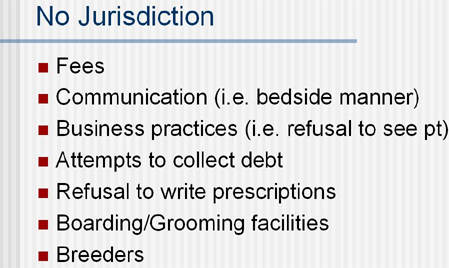
Please note that the Board only has the legal authority to investigate cases that indicate there has been a violation of the law or rules governing the practice of veterinary medicine. For instance, the Board does not have jurisdiction over money matters between a veterinarian and a consumer.

If it is determined that the Board has jurisdiction of a complaint, the Board will then make one of the following determinations of the complaint:

  1. Close the case due to no violation of law and rules;
  2. Direct the board staff to obtain the medical records, statement of the licensee implicated, and any other documentation; or
  3. Pursue further investigation which may entail interviews, inspections, etc.

Do not contact an individual board member about your complaint. If you contact a board member about your complaint, the board member must excuse himself/herself from any discussion and/or vote on your complaint.

After the investigative report/medical record/document is reviewed by the board members, the board will determine whether there is a violation of the law and rules governing veterinary medicine and take appropriate action if necessary. If the Board makes a motion to charge the licensee for a violation and it is approved, a notice of such will be sent to the licensee. The licensee will have 30 days in which to request a hearing.

The hearing process:

If a hearing is requested, a hearing is scheduled before a Hearing Officer. Both sides will be provided an opportunity to present their case, evidence and witnesses. Please keep in mind that the complainant may be issued a subpoena and be required to testify.

In the event that there is no request for a hearing received within the 30-day period, the Board may schedule a hearing to present evidence and witnesses, citing Goldman v. State Medical Board of Ohio (1996), 110 Ohio App.3d 124, 673 N.E.2d 677.

After the hearing, the Hearing Officer issues a Report and Recommendation to the Board. A copy of the Report and Recommendation is also sent to the licensee. The licensee is given 10 days from the receipt of the Report and Recommendation to submit any objections. The Board then reviews the Report and Recommendation and any objections filed by the licensee and either approves, disapproves or modifies the Report and Recommendation. The Board decides on the appropriate disciplinary action and issues an Adjudication Order. The Adjudication Order may be appealed in the Court of Common Pleas of the licensee's county of residence or business.

state home
privacy policy